







 |
|||||||||||||||||
|
 |
||||||||||||||||
 |
|||||||||||||||||
 |
|||||||||||||||||

















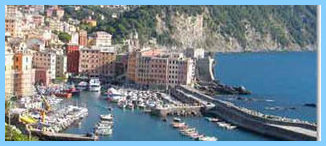
THE TUNA TRAP OF CAMOGLI di Annamaria "Lilla" Mariotti(Testo della conferenza tenuta in USA)  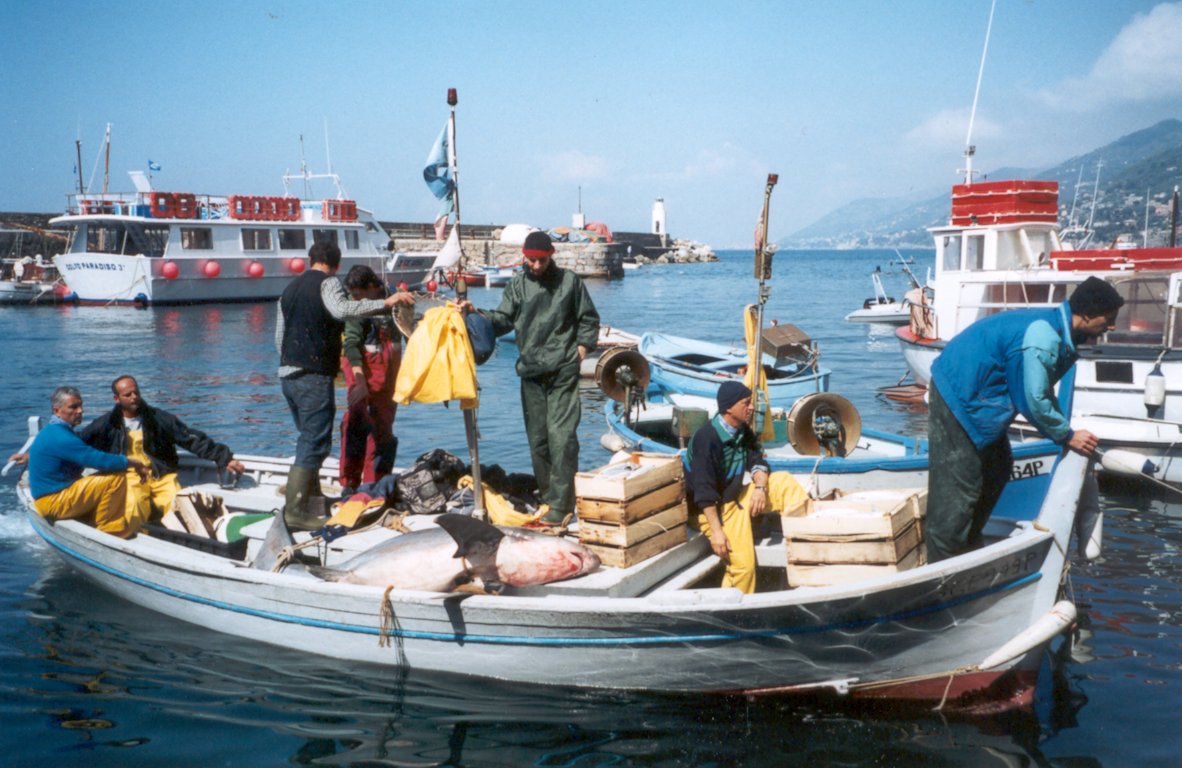 This is the story of a fish, a net, and of the men who work with it. This is also the story of a very ancient Mediterranean fishing tradition which has existed for thousand of years and that is at risk of disappearing.
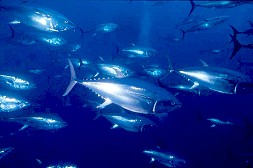
The fish I am talking about is the bluefin tuna, ( Thunnus thynnus, Linnaeus 1758 ) called red tuna in Italy, because of its meat which is red and very much appreciated by working people and gourmets alike. For thousand of years the bluefin tuna has been a great natural economic resource for all the Mediterranean area, there was work for fishermen, net and boat builders and every one involved with this kind of fishing.
The bluefin tuna is a pelagic fish, it is very powerful, it can swim very long distances each day, it can live long time, probably more than 50 years, and its weight can reach 500 kilos (about 1,000 pounds). It eats great quantities of squid, crustaceans and fishes and it has no enemies except sharks and men. Its meat has been used since the most ancient times, there is a painting in a cave on an island near Sicily, showing this fish, which is dated back to 9000 B.C. The Greeks and the Romans wrote a lot about this fish and we can find recipes and descriptions of the bluefin tuna in ancient manuscripts and on vases and paintings. The Romans in particular used the interior of the tuna for the preparation of a sauce called "GARUM" which was very much appreciated at that time. In the past, bluefin were captured in Italy on the coasts of Sardinia and Sicily. At the place it was captured, the fish was butchered in specialized factories. Virtually all of the fish was used, the muscle was canned, the heart and ovaries were preserved in salt, part of the meat was consumed in the fresh market and the head was processed for oil.
The bluefin tuna migrates every year from the cold North Atlantic waters through the Straits of Gibraltar to the warmer waters of the Mediterranean where it spawns beginning in the West in May and continuing across the sea to the Est where it finishes its reproductive cycle in the Aegean Sea and on the coasts of Turkey. After the spawning period and after the young tuna are hatched, they spend their first year or more in the Mediterranean and then the bluefin follows the same return path to the Atlantic Ocean and everything will start again the next year. Recent studies show that some of the fishes remain in the Mediterranean. These fishes are called "standing".
The ancient net system of catching the fish called the TONNARA originated from the study of the habits of the tuna. Because it swims near the coast, men built a net that goes perpendicular to the coast towards the open sea, and this directs the tuna to a sequence of "rooms", made of net, where the tuna enters and where it swims from one room to another, untill it reaches the last one : the camera della morte, the room of death, from where it cannot escape. This is the TUNA TRAP.
In Italy, in past centuries, there were a lot of Tuna traps, the biggest and most numerous were along the coasts of Sardinia and Sicily, but now there are only a few left, two in Sardinia, two in Sicily and one in Camogli, the only one in the North of Italy.
This TONNARA is very old, the first written records date back to the 17th century, but it is believed to be more ancient because in 1300 there was a tuna trap already working in the near town of Portofino and it was not the only one. In 1603 the authorities of the time declared that a certain quantity of the captured tuna had to be given to the population, this was to support the less wealthy people. In 1612 another decree stated that only men of Camogli could work at the tonnara and again it is said that free tuna must be gived to the people of Camogli. This edict was repeated during the centuries until 1817.
The 17th century must have been a golden century for the tonnara of Camogli. It was the most important of all others on the Italian Riviera and it was very rewarding for with its proceeds it was possible to renew roads, to extend the old pier in the harbour and even to build a Sanctuary on an hill surrounding Camogli, where the Holy Virgin appeared to a young sheperdess in 1518. People working on the sea are very pious.
During the 1700's there was not much written on the tonnara, we only know that it was still working. During the 1800's the story develops through alternate events. The Tonnara of Camogli was no more the first in its field because there began to be a shortage of tuna and to keep the tonnara rewarding the fishermen started to catch any kind of fish that came into the nets. In 1877 the tonnara was put up for auction and in the following years it had many different owners. At the turn of the century the tonnara was still operating. Records report that in 1913 it caught 4,400 punds of tuna and in 1914 was again the most productive among all the other tonnaras operating in Italy, but in 1923 the installation was closed. In 1937, with a great ceremony in the Town Hall of Camogli e new Co-operative Association was created under the patronage of the Mayor of the time, a great friend of the fishermen. The tonnara operated, with a short stop during WWII, and it continued untill 1979. But nobody wanted to see this ancient fishing system come to an end, so in 1982 the newly created Cooperativa Pescatori di Camogli (A co-operative among the fishermen of Camogli) resurrected it and the tonnara is still working today.
The TONNARA OF CAMOGLI has been in the same location for centuries. There is a mountain at the East side of the town, called "MONTE DI PORTOFINO" (MOUNT OF PORTOFINO) and it is at the bottom of this mountain the the nets are located every year, in April, and there they stay untill the end of September. But the work begins during the winter; it is necessary to make the nets ready and this work it is made by the fishermen themselves. Among them is a fisherman that is 90 years old, who is already retired, but who still provides the treasure of his experience to the younger men and it is a very male culture. The ropes, which support the net and are the connection of the net to the anchors that shape the net, are twisted in a small village near Camogli, San Fruttuoso, using very ancient tools. The village can be reached only by boat. All of the nets and the ropes are made of coconut yarn which arrives every year from India, with the exception of the camera della morte, which is made of nylon. Only the camera della morte has a floor in the room. During the summer, while the nets are in the sea, a lot of small marine organisms and algae adhere to the nets and there is nothing else to do at the end of the season but to cut them and to leave them into the sea. As they are made of a natural material, they do not cause polllution. In fact, the fishermen recognize that the fouling organisms on the net are excellent habitat for larval and juvenile fishes and act as a small nursery. Only the piece made of nylon is recovered to be used again.
The tonnara has a roughly rectangular shape, it starts with the tail, which is anchored to a rock at the bottom of the mountain and that goes toward the deep sea. This reaches the installation, called the island, which, in this case, is made of two rooms, the fist one the "collection room" and the second one is the sadly known "death room". The Tonnaras in Sardinia and Sicily have six or more rooms. The walls of the net go as deep as 120 feet. A big boat, called "the arm-chair" is moored at one end of the death room. In the past times, the fisherme used to eat and sleep on the boat. Now they go back and forth three times a day from the harbour of Camogli by a smaller boat called "the donkey", because the load of the catch is carried on it. This boat is followed on a tow line by a smaller one, called "the look-out", because the chief guard of the crew uses this small boat to stay in the middle of the "death room" to see if the net is full of fish.
In the past the crew was made of at least twenty men, but now there are two crews of six men each who work in shifts every week. They go to the nets three times a day : at the first dawning, again in the mid-morning, and mid afternoon.
There are differences among the fishermen of Camogli and those of the other tonnaras. The tonnaras of Sardinia and Sicily have a man, whose title is Rais, who is the chief of the crew. He decides where and when to put the nets and when it is time for the "mattanza" (harvest). The fishermen are called "tonnarotti" (which means men of the tunas). There are at least five or six boats and each has a very unique and special name. When it is time to catch the fish, the tonnarotti carry out the "mattanza" which appears to be a cruel fishing method carried out with much ceremony. The floor net of the death room is raised at the order of the Rais and the tunas are landed one by one with a large gaff hook attached to a rope and the fish is pulled to the boat and placed in the bottom. A special tonnarotti then cuts two large arteries in the fish and it quicly bleeds to death in about 15 seconds. When you think about it, it is probably more humane that being tied to a line for several hours before being brough onto the boat. The "mattanza" is carried out among ancient songs and shoutingt, while the water boils over the dying fishes.
The men of Camogli don't like exotic names, they are proud to be just fishermen and the head of the crew is only the "Chief Guard". In the tonnara of Camogli there is no "mattanza", the net is lifted by the six men in great silence, only a few words, and some vivid phrase if something goes wrong.
Now is getting more and more difficult every year to put a crew together. Young people don't feel like to afford such a hard work and older people, after many years of work in the tonnara, are waiting to retire, but they cannot find young fishermen to whom to teach this ancient art. This is why the tonnara is at risk of disappearing, after centuries of traditions and this is why my aim is that to make people know its story.
|
 |
|||
 |
||||
 |
||||

| Site Map |